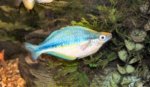
. Pelvicachromis
taeniatus ' Moliwe ' During 'fishing' scouting around in Cheshire a pair
was bought. Sadly the male lasted about a week (it seemed to die from lack of
oxygen).
Up to 17/04/06 the female lived in a tank by itself quite happily.
On 19/04/06 I purchased another Male.
On arriving back home I found the female
in dire states…lying on its side almost dead. I transferred it immediately
to another tank then introduced the male still in its plastic bag. The female
appeared to recover, so I released the male. At first the male had nothing to
do with the female, but since then the female has recovered completely and has
coloured up ready for spawning! Both fish charge the glass partition as P. taeniatus
' Lobe ' are in the adjacent tank.
On 22/04/06, I did a water change and
re-arranged the tank's décor, At the beginning of June (3rd) I walked
into the fish-house only to see the 'male' up side down in the inverted ceramic
igloo gasping for air. Oh no I'm going to lose it as well! I waited and a minute
or two he came out swam around and made for his cave where he lived apart from
the female. I then realised what he was doing…so with fingers crossed and
with a help of a small torch I shone the light into the igloo and saw a large
cluster of eggs stuck to the roof of the igloo. He was fertilising the eggs! His
colour had changed from pale yellow/ light greyish flanks to 5 faint black blotches
along his lateral line and he has rarely left the entrance to the female's igloo.
The female began to be secretive as she just hung in the entrance, blocking my
view of the sequence in the development of the eggs.
About June 5th wrigglers
appeared within and 6 days later, I could see free-swimming fry. On June 12 the
brood appears to be split into two, one lot being looked after by the male in
'his' cave whilst the other were within the female's cave. The fry number about
20-30 and are a light sandy colour.
The male is 3inches: female about 1½
-2 inches her colour is now very bright purplish/silver sheen on her body with
yellow lips. PH: 7.02, Conductivity 259-310, KH 4, Temp 79-81°F. The tank
is decorated with fine sand, ceramic pots & broken pieces, Java Moss and a
box filter. No heater is in the tank. (As the fish house is heated by a pipe heater).
The water changes have not been done for over 14 days. The parents are fed frozen
Bloodworm and flake, whilst the fry are fed Tetra Baby Powder™. The
male shoals his share of the fry around the tank, whilst the female is reluctant
to come out with her charges if at all. (Has the female in the past been removed
and doesn't know what to do?)<15/06/2006> when the female ventures out the
male tries in vain to stop her from getting into her 'cave' (igloo). Later that
day I observed the female now herding all the fry around the tank, but mainly
she seems to hide them behind the box filter. The male sometimes accompanies the
female + fry or stays within the vicinity.18/06/2006. During the next week or
two the number of fry appears to have diminished in number.
On 04/07/2006
since the tank looked a bit grubby so I did a water change. The fry number 8-12
and are ¼-½inch long. They tend to hide out of sight a great deal,
at times when I look into the tank I don't see them at all, then the next day
they are there somewhere near the female foraging in the sand. 06/07/2006
since it appears the female is showing signs of I hope re-breeding again, the
sand has been removed away from around her cave, the fry have been left to mooch
around the tank by their selves, so I've started to catch them (if I can find
them) and transfer them to another tank. To date I've found 6 & put them into
another tank. I would be extremely interested to hear from any fellow Aquarists'
who may have experienced difficulties with the keeping and breeding of our subject
specie. You can contact me by e-mailing a message, via the Otley Aquarist Society
e-mail contact address, which Arthur will then pass onto me.
Ian Fairweather
© July 2006 |