The Aquarists' Fish: The Headstander
By Dr David Ford, Consultant
to Aquarian®, member of Halifax AS.
As Hans Baensch says in the 'Aquarium
Atlas' - "Anyone who has not kept this fish cannot be called a true aquarist".
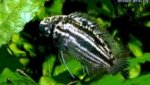
He is referring to the most popular of all the Headstanders the Striped Anostomus,
Anostomus anostomus. The reason is that this fish has all the attributes for survival
in the home aquarium, but is still a challenge to keep and breed in captivity.
The
fish lives in the rivers of the Amazonian Rainforest, in the fissures of rocky
faces where it picks at the algae. It lives with large shoals, but will leave
the group to forage for insects and worms to supplement the herbivorous diet.
This
means it can live in a community aquarium as a lone specie, or be part of a large
shoal in a theme tank. However, with rocky face living (just like many Rift Valley
Cichlids) the fish can be territorial, so provide some slabs of rock for the fish
to call home. Keep a shoal and they will group around this home, keep just a few
(say a trio) then each will try to own the space and aggression follows.
Since
the fish needs algae, a brightly lit aquarium is ideal. Live plants are not eaten,
but the fish needs the broader leaf varieties where it can peck at algal growth.
Water should be of medium hardness and slightly acidic, but it will accept ordinary
(dechlorinated) tapwater. Hence, again, the fish will live in the aquarist's average
tank, but to develop the fish's true colours the water chemistry must be controlled.
Those
colours are superb - the fish is the most colourful of all the South American
Characins with its zig-zag patterns, golden yellow stripes and blood red flashes
in the tail.
Breeding is also a challenge with no records of aquarium spawning
to date (unless any readers of this article have succeeded - let us know!).
My
Experience
I have tried - and failed - to get the Anostomus to breed. It
is claimed to be an egg scatterer and Killifish-style mops have been used. The
fish probably breeds at depth in the wild, something that cannot be reproduced
in the usual 15" (38cm) deep aquarium. For pairing there is little sexual
difference, the males are just slightly slimmer. I never produced a female fat
with eggs, despite an ideal diet and conditions.
That ideal diet was Aquarian®
flake plus Spinach (baby food from a jar) and the occasional worm (clean, home-bred,
live tubifex). On this food the fish grew to the maximum size (quite large - 5
inches/12cm) and lived several years, but there were no descendants to continue
the trials in the Waltham® Aquacentre.
The Headstanders
Another
special attraction of the Striped Anostomus is its peculiar swimming habit, with
the head downwards - which, like Concorde, rises with speed! The fish also topples
over as it grubs in the base sand (which is better than gravel for these fishes)
for worms. This is because the mouth is upturned for algal grazing.
In fact
there are a whole family group of these 'Headstanders' from the Amazon river.
They all show the swimming or resting in the head down position and this gave
them their name. This is a universal name too - the Spanish call the fishes 'pez
verticales'.
They are all Characins with typical adipose fin and torpedo
shape. All are from the Amazon basin (and are therefore called the American Characins)
and, as usual, the common names are confusing. Because Anostomus anostomus is
the most popular, this fish is often sold as the 'Headstander', but the true 'Headstander'
is Abramites microcephalus, although sometimes the name is used for Chilodus punctatus
- which is really the Spotted Headstander.
___________________________BOX_________________________________
Species
Common Names Comments
Anostomus anostomus Striped Anostomus The most popular
Headstander
Abramites microcephalus Headstander Now renamed
High-back
Headstander A. hypselonotus
Chilodus punctatus Headstander Like Anostomus
Spotted Headstander but more timid
Anostomus fasciatus Six-barred Anostomus
Rare Anostomus
Anostomus gracilis Four-spot Anostomus Rare, but when
imported, usually
confused with the
three-spot
Anostomus trimaculatus
Three-spot Anostomus Will eat soft plants
Anostomus taeniatus Banded Headstander
American Indians
call this fish 'Lisa'
(actually the name
of the
discoverer)
Anostomus ternetzi Anostomus Less colourful than
the Striped
Anostomus
but more peaceful
There are other Headstanders but you
do not see them in the aquarium trade being rare or too large (in fact some are
caught as a food fish in the Amazon).
Why Stand on your Head?
The
aquarium literature (nor the Ichthyological literature) offers any reason for
the head-standing behaviour of the Anostomidae. However, when I carried out postmortem
examinations of Anostomus anostomus that eventually died it was obvious that the
swim bladder was further back than occurs in most fishes. Also, the bladder was
thinner to the front and wide at the rear - hence the reason for the head-down
posture. That doesn't explain why the fish has such a different swimbladder, but
certainly gives a reason for the head-down - the tail has to go up!
The
fishes are also Characins and so have the extra back fin (adipose), but there
is no scientific reason for this fin. Some claim it is vestigial (an organ that
has degenerated over millennia until useless) but others claim it gives added
stability in water dynamics. Perhaps the head-down is a consequence of a vestigial
shape swimbladder…however, fish such as A. anostomus can easily flip over
and browse upside down or right way round to gather algae from crooks and crevices.
This helps it survive in the wild, even if other foods are scarce, but does give
delightful antics in the home aquarium.
Be a true aquarist - get a Headstander,
or two, or a shoal.
Many Thanks to
Dr David
Ford, http://www.drdavidford.pwp.blueyonder.co.uk/