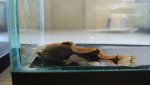
| Synodontis notatus was one of the
first African catfish which came into my care. These fish have great character,
are not demanding to maintain in aquaria but have the trait of loathing their
own kind. Synodontis notatus comes to us from the Congo Democratic Republic
and is known in our hobby under the common names of Onespot Synodontis, Onespot
squeaker or Spotted Synodontis. This is based on the original specimens to arrive
into the aquarium hobby, which had a muddy grey background body colour highlighted
by one large dark spot. Today we know that some specimens have no spots whatsoever
('0' spot variant) while the '6' spot variant has as many as 6 large and 3 tiny
(close to the caudal peduncle) spots upon their bodies. As visitors may by now
have guessed, the number of large spots becomes the recognition variant so a notatus
with 3 large spots is the '3 spot variant' etc. In young notatus the body
is straight aligned but as maturity is reached the body begins to arch. Although
all the fins appear clear the dorsal carries a light red hue. It is believed that
at breeding time this red hue intensifies, particularly in the male, to become
a pairing recognition signal. Synodontis notatus is capable of growing to
a size of 11" so an aquarium no smaller than 36x12x12" is required to
house these fish. They prefer a high temperature of 27 C and a pH of 7. Substrate
of fine gravel. Some notatus like the safety of ceramic caves whereas other prefer
to mid-water swim in open areas. Feeding causes no problems as both large flakes
and catfish pellets are avidly devoured. Please note that these fish can bite. Young
notatus should not be kept with their own kind, whom they often loathe, and use
'pecking order' disputes as an excuse for further conflict. They will give no
ground to Synodontis of any type, and of similar size, resorting to 'nip and 'bite'
tactics in order to get their own way. It is surprising just how aggressive they
can become attacking with all fins flared and erect. They will also take on 'all
comers' in bouts of 'mouth wrestling'. As adults things change as these
fish will live, as a single specimen, in relative harmony, but not giving way
in any tussles over food items or territory. The Onespot variety in my care lives
quiet happily in the company of a group of Synodontis eupterus (Ornamentfin/Featherfin
catfish), several mixed Synodontis, L001 and a number of variously sized Tilapia.
Living with their own kind though remains a different story as they continue to
loathe the company of each other and although not as aggressive their increased
physical power will see them take 'pecking order' feuding to a much higher level
leaving physical damage to each others bodies and fins. Please remember
that the pectoral spines of notatus are very sharp and thus can inflict damage
to the human hand. The pectoral fins of all Synodontis are very special as they
record growth periods like the rings of a tree and are used by ichthyologists
to correctly recognise Synodontis with very similar colour patterns and body size.
In the wild notatus breed during the rainy season when rivers break their
banks spilling water over grasslands. From what we have already mentioned the
red colouration in the dorsal fin increases at this time and as well as a signalling
point to potential partners perhaps it acts as a flag of placidity to ease the
violent temper of mature adults during the spawning season? Very little is known
about the spawning act but the hatchling fry feed upon micro-organisms and grow
quickly so that when the dry season arrives they are large enough to survive in
the main river channels. As yet I know of no aquarium spawning reports
but commercial breeding is said to be underway in the Far East and there are rumours
that notatus with rounded faces, as a result of hormone stimulation, have appeared
on the European Mainland.
By David Marshall, Ryedale
Aquarist Society
|